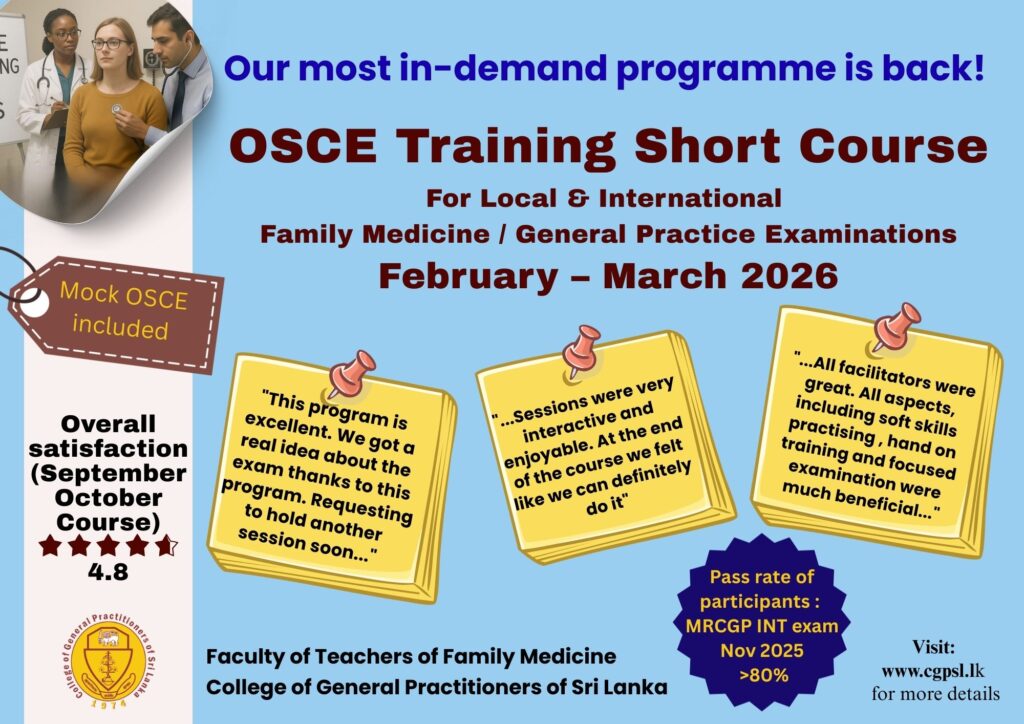
OSCE Training Short Course
REGISTRATION CLOSED
For Local & International Family Medicine / General Practice Examinations
(Suitable for MCGP, MD, DFM, MRCGP [INT] and PGIM Family Medicine selection exams)
Sharpen your skills. Boost your confidence. Excel in your OSCEs.
Join our intensive, hands-on training programme specially designed to prepare candidates for local and international Family Medicine OSCE-style examinations.
Unique Features:
- Led by a panel of experienced OSCE examiners
- Live case discussions
- Structured opportunity for all participants to practise
- Simulated Patient (SP)-based OSCE scenarios
- Hands-on OSCE examination training
- Video-assisted marking and feedback
- 4 days (03 full days and one afternoon)
- Mock OSCE included
- 4 OSCE stations + 2 OSPE questions
- Examiner feedback after each station
- Debriefing session at the end
Dates
Saturday, 7th February: 1pm – 5pm
Sunday, 15th February: 9am – 5pm
Sunday, 22nd February: 9am – 5pm
Sunday, 01st March: 9am – 5pm
📌 Venue: SLIDA, Colombo 7
Mock OSCE: Sunday, 08th March 2026
📌 Venue: PGIM Academic Centre, Rodney Street, Colombo
Course Fee:
Full course: (Including Mock OSCE): Rs 42,500
Mock OSCE only: Rs 15,000
 Limited slots available – register early!
Payment details & Application method:
Easy payment system available. Please refer “Payments” page for details.
Pay online through the payment button below,
or
Transfer cash to the account number mentioned below.
AND
Fill the Registration form given below & upload the payment slip
Online bank transfers;
- College of General Practitioners of Sri Lanka
- Account No: 000 46 0000 661
- Bank: Sampath Bank, Borella Branch
- Enter your Name in the “Reference/Remarks/ Narration” section
For clarifications:
WhatsApp (Messages only) : 0773079100
Tel No: 011 2698894
Course Objectives
The objectives of this course are to:
1. Familiarise participants with the OSCE format used in local and international Family Medicine / General Practice examinations, including station structure, marking schemes, time management, and examiner expectations.
2. Enhance communication, interpersonal, and counselling skills essential for OSCE success and patient-centred care in primary care settings.
3. Develop competence in systemic clinical examination, focusing on core systems commonly assessed in Family Medicine / GP OSCEs locally and internationally.
4. Strengthen practical examination skills through demonstrations and hands-on practice in frequently tested procedures and focused examinations.
5. Improve clinical reasoning and case management skills through live case discussions and integrated OSCE-style scenarios relevant to primary care practice.
6. Increase confidence and consistency in OSCE performance through repeated, structured practice aligned with recognised Family Medicine examination standards.
7. Expose participants to common OSCE pitfalls and examiner perspectives, drawing on experience from both local and international Family Medicine / GP assessments.
8. Prepare participants for formal Family Medicine / GP OSCE examinations, locally and internationally, through targeted revision and a mock OSCE with structured feedback.
Coordinators:
Dr Sankha Randenikumara
Dr Priyanthi Premarathne
Panel of Trainers:
Dr A L P de S Seneviratne
Dr Chandana Atapattu
Dr Shihari S Abeysena
Dr Sankha Randenikumara
Dr Priyanthi Premarathne
Dr Dilini Baranage
Dr Manoj Liyanage
Dr Ajay Jeyaseelan
Dr Anojana Jeyaseelan
Main Topics covered at our OSCE Training Short Course
- Introduction to OSCE format and examination strategies
- Communication, interpersonal, and counselling skills
- Systemic clinical examination
o Cardiovascular system
o Respiratory system
o Abdominal system
o Neurological system
o Musculoskeletal system - Endocrine and focused examinations (thyroid, diabetic foot)
- Demonstration of examination skills (eye, ENT, blood pressure, peak flow meter)
- Psychiatry and behavioural medicine in primary care
- Dermatology in primary care
- Men’s and Women’s Health
- Palliative Care
- Ethics
- Integrated OSCE practice and live case discussions
- OSCE tips and feedback
- Video marking
- Mock OSCE
Programme Outline
Day 1 – Foundations of OSCE and Communication Skills
Saturday, 7th February
1.00 – 2.00 pm
Introduction to the OSCE
- Welcome and course introduction
2.00 – 3.30 pm
Core Communication Skills
- Doctor–patient communication
- Interpersonal skills in OSCE stations
- Case discussions
(Working tea included within the session)
3.30 – 5.00 pm
Counselling Skills in General Practice
- OSCE-style counselling scenarios
- Case discussions
Day 2 – Clinical Examination Skills I
Sunday, 15th February
9.00 – 11.00 am
Neurological System
- Examination techniques
- Case discussions
11.00 – 12.00 noon
- Psychiatry cases
- Dermatology cases
12.00 – 1.00 pm
Demonstration of Core Examination Skills
- Eye examination
- ENT examination
- Blood pressure measurement
- Peak flow meter
1.00 – 2.00 pm – Lunch
2.00 – 3.00 pm
Abdominal Examination
- OSCE-focused approach
- Case discussion
3.00 – 5.00 pm
Women’s Health and Related Clinical Topics
- Contraception case
- Menstrual disturbances
- Menopause (if time permits)
- STI case discussion
(Working tea included within the session)
Day 3 – Clinical Examination Skills II
Sunday, 22nd February
9.00 – 11.00 am
Musculoskeletal System
• Examination techniques
• Case discussions
11.00 am – 1.00 pm
Chronic Disease and Endocrine
• Diabetic foot examination
• Diabetic case discussions
• Thyroid examination and case discussion
(Working tea included within the session)
1.00 – 2.00 pm – Lunch
2.00 – 5.00 pm
Cardiovascular System and Communication-Focused Stations
• CVS examination and case discussions
• Breaking serious news – case discussions
• Palliative care case discussion
(Working tea included within the session)
Day 4 – Clinical Examination Skills IIl, Special Topics and Examination Preparation
Sunday, 1st March
9.00 am – 12.00noon
Respiratory System
• Examination skills
• Case discussions
(Asthma, COPD, OSA)
12.00 – 1.00 pm
Alcohol-Related Consultations
1.00 – 1.45 pm – Lunch
1.45 – 3.45 pm
Men’s Health and Paediatrics
• Erectile dysfunction and premature ejaculation
• Paediatric OSCE-relevant topics
(Working tea included within the session)
3.45 – 4.30 pm
Video Marking and Group Discussion
4.30 – 5.00 pm
Final Preparation
• Question and answer session
• Feedback
• Final examination advice
Day 5 – Mock OSCE
• Full Mock OSCE (morning or afternoon session)
• Individualised feedback
• Examiner comments
• Personalised improvement plans